Skip to content
fonteum
DataAPIRisk SignalsResearchCompareSnapshotsRequest access →

Compliance posture

Methodology · Corrections log · Editorial policy

fonteum

Product

  • Data
  • API
  • Methodology
  • Sources
  • Freshness
  • Citations
  • Moat metrics

For buyers

  • AI agents
  • RAG developers
  • Compliance
  • Researchers
  • Developers

Reference

  • Compare
  • llms.txt
  • Agent card
  • Audit pack
  • Quality scorecard
  • Pilot intake
  • Research
  • Press & media

Sourced from federal agencies. Fonteum, Inc., Delaware C-corp. © 2026.

Fonteum is a US healthcare provenance registry.

About Fonteum ›

Fonteum is a US healthcare provenance registry that publishes signed, chain-of-custody-attested research and data pages on Medicare, Medicaid, and federal regulator datasets, drawing from 22 federal source families across CMS, OIG, HRSA, AHRQ, and HHS.

Request access→
1,322,867 nurse-staffing records · CMS PBJ
Fonteum · Data · NPPES NPI Registry
NPPES
Dataset confidence
95%

CMS NPPES NPI Registry Data

Fonteum wraps the CMS National Plan and Provider Enumeration System —

6.8 million+ active providersSource: https://npiregistry.cms.hhs.gov/ · Dataset: nppes/v1 · Snapshot: 2026-05-01
across — with per-field provenance, FHIR R4 US Core output, and bulk export via the HL7 $export specification. Health-tech teams and analytics platforms use this layer to build NPI-keyed data pipelines without managing the weekly full-file parse cycle themselves.
See the Audit Pack →Talk to a data engineer →
Reviewed by Jennifer Montecillo, MD, medical reviewer. Non-practicing medical reviewer.Last reviewed: June 2026 · Next review: December 2026 · Data last updated (dataLastUpdated): 2026-05-28About our reviewers →
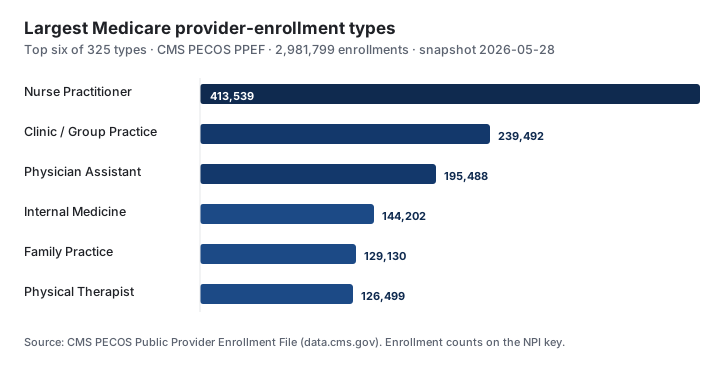
Bar chart: the six largest CMS Medicare provider-enrollment types in Fonteum's PECOS backbone — Nurse Practitioner 413,539, Clinic/Group Practice 239,492, Physician Assistant 195,488, Internal Medicine 144,202, Family Practice 129,130, Physical Therapist 126,499; snapshot 2026-05-28.
Source: CMS PECOS Public Provider Enrollment File (data.cms.gov) · snapshot 2026-05-28.
  • Enrollment analysis
  • Methodology
  • Source comparison
  • Sources
Data sourcesProvenance chainData freshnessProvider profilesOIG sanctionsNPI anatomy guide
Primary federal sources:CMS data.cms.gov ↗NPI Registry (cms.hhs.gov) ↗OIG oig.hhs.gov ↗
Risk signals (live)

Deterministic anomaly detection across the NPPES dataset

Every provider record is continuously checked against 5 deterministic rules: OIG exclusion status, anomalous payment patterns, specialty mismatches between NPPES and PECOS, enrollment lapses, and claim inactivity. Each signal cites the exact source row that triggered it — no ML black box, no confidence scores without evidence.

OIG Exclusion6d ago
NPI: 1942476080
LEIE row ID27
Type1128b8
Exclusion date2017-05-18
DescriptionDME COMPANY
Dataset release2026-05-08
Source: OIG LEIE Exclusions List
OIG Exclusion6d ago
NPI: 1891731758
LEIE row ID34
Type1128b8
Exclusion date2017-05-18
DescriptionOTHER BUSINESS
Dataset release2026-05-08
Source: OIG LEIE Exclusions List
OIG Exclusion6d ago
NPI: 1972902351
LEIE row ID3
Type1128b8
Exclusion date2022-03-20
DescriptionOTHER BUSINESS
Dataset release2026-05-08
Source: OIG LEIE Exclusions List
OIG Exclusion6d ago
NPI: 1922348218
LEIE row ID7
Type1128a1
Exclusion date2018-04-19
DescriptionOTHER BUSINESS
Dataset release2026-05-08
Source: OIG LEIE Exclusions List
OIG Exclusion6d ago
NPI: 1275600959
LEIE row ID31
Type1128a1
Exclusion date2013-03-20
DescriptionOTHER BUSINESS
Dataset release2026-05-08
Source: OIG LEIE Exclusions List
OIG Exclusion6d ago
NPI: 1265830335
LEIE row ID44
Type1128a1
Exclusion date2022-08-18
DescriptionDME COMPANY
Dataset release2026-05-08
Source: OIG LEIE Exclusions List

What is NPPES?

The National Plan and Provider Enumeration System is the CMS-administered registry that issues and tracks National Provider Identifiers. Every provider and organization that bills federal health programs — physicians, nurses, chiropractors, dentists, therapists, labs, hospitals, and supplier entities — is enumerated in NPPES. The NPI is the universal key for claims processing, credentialing, clinical directory queries, and cross-source data joins across the entire federal provider data ecosystem.

The NPPES full-file download covers approximately 8 million records, with 6.8 million+ active providers at any given snapshot. Records include NPI, provider type (individual vs. organization), name, practice address, mailing address, taxonomy code and description, enumeration date, last-update date, and deactivation date where applicable. The file is published weekly on Sundays as a flat CSV; Fonteum ingests it within 48 hours. For a field-by-field breakdown of NPI structure, the check-digit algorithm, Type 1 vs. Type 2 entity encoding, and NUCC taxonomy codes, see the NPPES data-model deep-dive.

Limitations: NPPES is self-reported. Providers update their records on an honor-system basis; address and specialty data can lag real-world changes by months. Fonteum's provenance layer records these limitations per field rather than presenting NPPES data as a ground-truth authority. The methodology page documents a 6.8% known address mismatch rate against the 2025 CMS Care Compare reference set.

The FHIR R4 wrapper and provenance layer

Fonteum maps each NPPES record to the HL7 FHIR R4 US Core 6.1.0 Practitioner profile and exposes it at /api/fhir/Practitioner/{NPI}. Organizational NPIs map to the US Core Organization profile at /api/fhir/Organization/{NPI}. The CapabilityStatement at /api/fhir/metadata declares full USCDI v3 Provider conformance across five resources.

Each FHIR resource carries a 14-tuple provenance tagon meta.tag using Fonteum's coding system, encoding source family, snapshot date, methodology version, field-level confidence, and cross-reference status. This makes the provenance machine-readable without requiring consumers to call a separate API to understand where each field came from.

Bulk export: the HL7 FHIR R4 Bulk Data Access $export endpoint at /api/fhir/Practitioner/$export delivers the full 6.8M provider corpus as NDJSON, signed with SMART Backend Services OAuth 2.0. Suitable for warehouse ingestion, embedding pipelines, and large-scale analytics without per-record polling.

Who uses NPI data with provenance

Payer credentialing platforms

Primary-source credentialing for network rosters requires NPI-keyed lookups with a documented retrieval timestamp for audit purposes. Fonteum's per-field provenance satisfies the CAQH and URAC credentialing documentation requirements without custom tooling.

Patient navigation and access platforms

Finding in-network providers by specialty, accepting-new-patients status, and location requires a clean, taxonomy-normalized provider dataset. NPPES is the primary source; Fonteum adds address validation, taxonomy normalization, and real-time FHIR queries.

Healthcare analytics and data vendors

Analytics products that enrich claims data, market-size models, or referral-pattern analysis all anchor to NPI. Fonteum's bulk export with provenance metadata makes the weekly refresh a managed dependency rather than a bespoke ETL job.

Frequently asked questions

What is NPPES and what data does it contain?
The National Plan and Provider Enumeration System (NPPES) is the federal registry maintained by CMS that assigns National Provider Identifiers (NPIs) to every healthcare provider and organization that bills federal health programs. Each NPI record includes provider name, address, taxonomy code (specialty), enumeration date, NPI type (individual vs. organization), and NUCC credential details. Fonteum ingests the NPPES weekly full-replacement file — approximately 8 million records covering 6.8M+ active providers — and parses it into structured, query-ready form.
How does Fonteum's NPPES layer differ from the public NPPES API (NPI Registry)?
CMS provides a public NPI lookup API at npiregistry.cms.hhs.gov with per-record query support. It does not offer bulk export, field-level provenance, or FHIR-compatible output. Fonteum adds bulk $export over FHIR R4 Bulk Data Access, per-field fourteen-field provenance (source, source_url, dataset_id, snapshot, methodology, last_checked, confidence, availability, and six additional fields), taxonomy-code normalization against the NUCC Health Care Provider Taxonomy code set, and cross-source joins to CMS PECOS PPEF and OIG LEIE on the same NPI key.
Does Fonteum provide NPPES data for all provider types?
Yes. The NPPES file covers Type 1 (individual) and Type 2 (organizational) NPI holders across all 120+ NUCC taxonomy codes — physicians, nurses, dentists, chiropractors, therapists, labs, hospitals, group practices, and suppliers. Fonteum ingests the full file without specialty filtering. Taxonomy-specific subsets (dermatology, chiropractic, plastic surgery) are available as pre-filtered exports through the data-platform catalog.
Can I use Fonteum's NPI data to build a provider directory or lookup tool?
Yes, subject to the data-platform agreement and attribution requirements. NPPES data is published under U.S. Government Works and is freely redistributable. Fonteum's provenance layer and API infrastructure carry separate terms. For provider-directory builds at scale — including deduplication, address normalization, and taxonomy mapping — Fonteum's audit-pack export is the fastest path to a clean, structured provider dataset.

Access the NPPES data layer

The Audit Pack includes a pre-built NPPES export matched to CMS Care Compare and LEIE on NPI. For bulk FHIR access, custom taxonomy filters, or dedicated delivery schedules, contact the data engineering team.

Download the Audit Pack →Data Platform overview →
Original analysis · Medicare provider enrollment

What the provider population looks like, on the NPI key

Fonteum's provider backbone joins the NPPES NPI registry to the CMS PECOS enrollment file on the shared NPI. In the current snapshot it holds

2,981,799Source: https://data.cms.gov/provider-characteristics/medicare-provider-supplier-enrollment · Dataset: cms-pecos-ppef/v1 · Snapshot: 2026-05-28
Medicare enrollment records spanning distinct NPIs across 56 states and territories and 325 CMS provider types — 85.5% individual practitioners and 14.5% organizations. Every record carries field-level provenance back to its CMS source file and snapshot date.

2,556,656
Distinct NPIs in the provider backbone
2,548,303
Individual (Type 1) enrollments — 85.5% of records
433,496
Organizational (Type 2) enrollments — 14.5%
325
Distinct CMS provider/supplier types represented

Compliance posture

Methodology · Corrections log · Editorial policy

How current is Fonteum's NPPES data and how is freshness tracked?
CMS publishes a full NPPES replacement file weekly on Sundays. Fonteum ingests it within 48 hours and tags each snapshot with a retrieved_date, snapshot_hash (SHA-256 of the source file), and methodology_version. Freshness is visible on the /sources/nppes reference page and queryable via the API's meta.lastUpdated field on any FHIR Practitioner resource.

Largest provider-enrollment types

Nurse Practitioner413,539
Clinic / Group Practice239,492
Physician Assistant195,488
Internal Medicine144,202
Family Practice129,130
Physical Therapist (private practice)126,499

Top states by enrollment volume

CA262,214
TX207,328
NY198,758
FL185,769
PA127,899
IL109,875

Related Fonteum surfaces: the per-provider profiles render each NPI with its field provenance, the OIG sanctions surface cross-joins exclusions on the same key, and the data catalog lists every federal source.

Source: CMS PECOS Public Provider Enrollment File (data.cms.gov)·Last checked: 2026-05-28·signed badge ↗
Data provenance

Methodology

Counts are computed directly from CMS primary files — the weekly NPPES full-replacement file and the monthly PECOS enrollment file — not from an aggregator. The pipeline runs in five stages: (1) source acquisition from data.cms.gov, (2) entity resolution on the NPI, (3) NPPES-to-PECOS join on the NPI key, (4) quality checks against published CMS record counts, and (5) chain attestation. Each value is asserted and chained, then labeled with its provenance — attested, signed, or provenance-tracked — never with unbacked trust language.

dataset_id
cms-pecos-ppef/v1
source_agency
CMS (data.cms.gov)
snapshot_date
2026-05-28
methodology_version
nppes/v1

These four headline fields begin the 14-tuple provenance chain. The full contract — through entity_id, confidence_tier, chain_link_hash, and attested_at — is documented on the data sources reference.

How this data is measured

Source comparison: grain, cadence, and access

SourceData grainCadenceAccessProvenance
FonteumNPI-level + field provenanceWeeklyAPI + bulk $export, free base14-tuple chain
CMS NPI Registry APINPI-level (per-record)DailyFree, no bulk exportNone
Definitive HealthcareProvider / affiliationQuarterlyPaid subscriptionNone
IQVIA OneKeyProvider / claimQuarterlyPaid enterpriseNone
Primary sources

Sources

  1. NPPES NPI Registry — Full Replacement File — Centers for Medicare & Medicaid Services (CMS), Weekly. Primary source ↗ · Archive ↗
    Used for: NPI identity, taxonomy, names, addresses, enumeration and deactivation dates.
  2. PECOS Public Provider Enrollment File (PPEF) — Centers for Medicare & Medicaid Services (CMS), Monthly. Primary source ↗ · Archive ↗
    Used for: Medicare enrollment status, provider type, and reassignment on the NPI key.
  3. NPI Registry public lookup API — Centers for Medicare & Medicaid Services (CMS), Daily. Primary source ↗ · Archive ↗
    Used for: Per-record cross-check of a single NPI against the live CMS registry.
  4. OIG LEIE — List of Excluded Individuals/Entities — U.S. Department of Health & Human Services, Office of Inspector General, Monthly. Primary source ↗ · Archive ↗
    Used for: Federal-exclusion cross-join on the same NPI key (sanctions overlay).

Data last updated: 2026-05-28 · Reviewed by Jennifer Montecillo, MD · June 2026. Non-practicing medical reviewer.

Cited in 1 study
  • Why 14% of skilled nursing facilities had a quality drop in Q1
    2026-05-12 · 8 min